
How to store photos of your ID safely on your phone
Published October 1, 2026
A photo of your ID card or passport is one of the most valuable things on your phone — to you, and to anyone who wants to open an account, take a loan or run a scam in your name. Yet most of us keep several, taken in a hurry for one form or one hotel check-in and then forgotten in the camera roll.
This guide is a routine you can follow with nothing but your phone's built-in tools. The short version: keep as few copies as possible, mark the ones you send, and lock up the ones you keep.
Step 1: Ask whether you need a photo at all
Many countries now have an official digital ID or government app that can show or share your details with proper authentication. Where a service accepts that, it is safer than a photo, because there is no image file to leak or forward.
If you only need the ID number for a form, write it in a locked note rather than keeping a picture of the whole card with your face, birth date and address on it.
Step 2: Watermark every copy you send
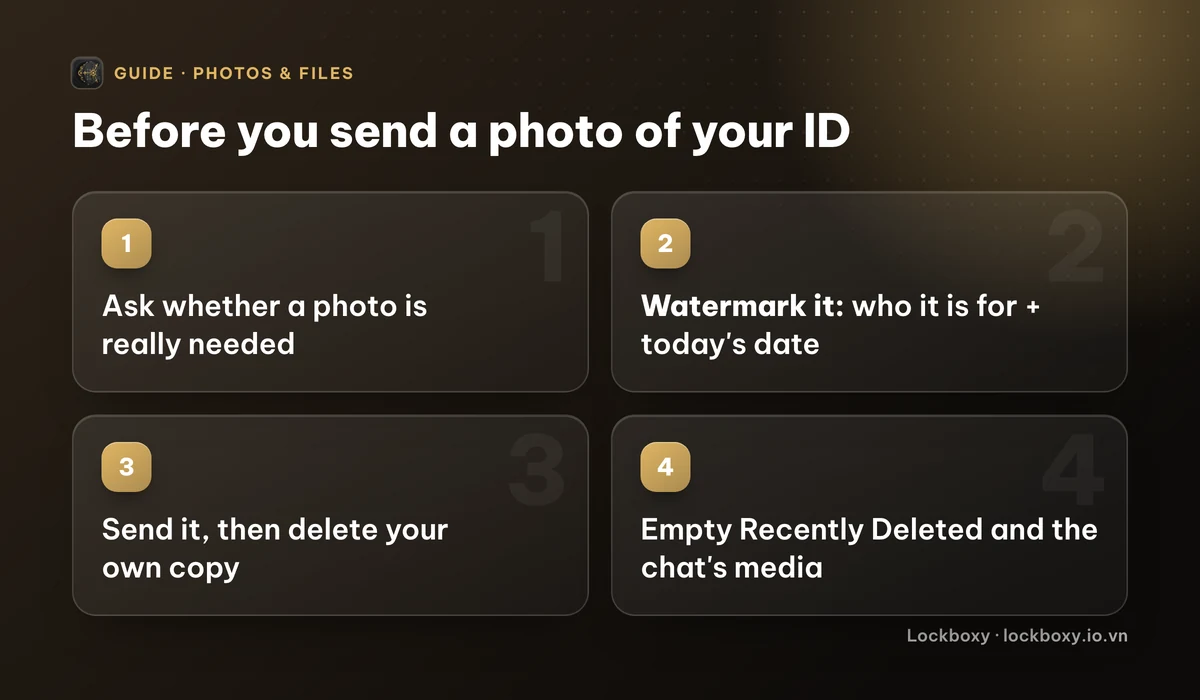
When a service really does need a photo, mark the copy with who it is for and when. A watermarked image is much harder to reuse for something else.
- 1Open the photo in Photos and tap Edit.
- 2Tap the Markup button (the pen icon).
- 3Add a text box such as “For [company] account opening only — [date]” and drag it across the card, without covering the number the service needs to read.
- 4Tap Done. Send this edited copy, never the clean original.
If you no longer need the photo after sending, delete both the original and the edited version.
Step 3: Find the copies you forgot about
Deleting the photo from your camera roll is rarely the end. Check each of these:
- Recently Deleted in Photos keeps deleted items for up to 30 days. Open it, then Select → Delete All (or delete just the ID photos).
- Chat apps often save received and sent images to their own storage or to your library. Search the chat where you sent the ID and delete the message for yourself (and for the recipient, if the app allows it and you no longer need them to have it).
- Cloud backups — iCloud Photos, Google Photos or another backup app — may still hold a copy after you delete it on the phone. Delete it there too and empty that service's trash.
- Email: search your Sent folder for attachments you sent to a bank, landlord or employer.
- Screenshots of your ID inside banking or e-government apps count too.
Step 4: Lock the copies you keep
Some copies are worth keeping — for example, a passport scan for travel emergencies. Put them somewhere that does not open just because the phone is unlocked:
- The Hidden album in Photos, with Use Face ID turned on in the Photos settings.
- A locked note in Notes, using a custom password rather than your phone passcode (see how to lock notes on iPhone).
- A dedicated encrypted vault with its own passcode (see below).
Avoid the general Files app or a cloud drive folder without a lock: anyone holding your unlocked phone can open those in seconds.
Step 5: Protect the phone itself
Every lock above depends on the phone not being wide open:
- Use a 6-digit or alphanumeric passcode, and do not reuse it as your banking PIN.
- On iPhone with iOS 17.3 or later, turn on Stolen Device Protection (Settings → Face ID & Passcode). It requires Face ID for sensitive actions when you are away from familiar places, so a thief who watched you type your passcode cannot simply change your Apple Account password.
- Never send ID photos to someone who contacts you first by phone or message, however official they sound. Legitimate services ask for documents through their own app or office.
Where Lockboxy helps
Lockboxy is built for exactly the files in this guide. Documents and photos are encrypted with AES-256 on the device, behind a passcode that is separate from your phone's, and there is no account or server holding a copy.
- Scan an ID, receipt or letter with the camera: Lockboxy finds the page edges, straightens each page and saves it into Files as one PDF or as images, encrypted. The suggested title is read on the device only.
- Photos taken with the in-app camera go straight into the vault and never into the Photos library, so there is no stray copy to clean up afterwards.
- You can also send an existing ID photo in from Photos or a chat app via the Share Sheet, then delete the original.
Keep in mind: if you forget the vault passcode and have no Recovery Key, nobody can open it. For documents you cannot replace easily, keep an encrypted backup somewhere you control.
Want a private place with its own passcode?
Lockboxy encrypts photos, videos, files and notes on your device, behind a passcode separate from your phone's. No account, no server.
Get Lockboxy on the App StoreMore guides
- What to do before sending your iPhone for repair
- How to permanently delete photos on iPhone (and every copy you forgot)
- How to store passwords safely on your phone
- How to hide photos on iPhone (and what “hidden” really protects)
- How to lock apps on iPhone: Face ID lock, hiding apps and older-iOS workarounds
- How to lock notes on iPhone with a password or Face ID
- How to lend your iPhone without exposing your photos
- How to store a seed phrase safely (and what not to do)
- How to take photos that don't save to your iPhone camera roll
- How to scan documents on iPhone (no app needed) and store them safely
- How to store 2FA backup codes safely (and where not to)
- How to handle sensitive screenshots on iPhone (bank transfers, OTPs, IDs)
- How to keep voice recordings private on iPhone
- How to stop iPhone photos syncing to your iPad and Mac
- What to do when your iPhone is lost or stolen
- How to erase your iPhone before selling it
- Lockboxy vs the iPhone Hidden album: which should you use?
- Lockboxy vs locked notes on iPhone: which is better for private notes?
- Phone privacy for livestream sellers: keep customer data off the stream
- Keeping client documents private: a phone routine for real-estate agents
- How to hide contacts on iPhone: what really works
- How to tell if someone went through your iPhone
- How to move private photos to a new iPhone
- How to password protect a folder on iPhone
- How to remove location data from photos on iPhone before sharing
- How to store bank card details safely on your phone
- How to find and share a saved Wi-Fi password on iPhone
- How to stop unwanted photos from showing up in Memories and Featured Photos on iPhone
- How to control which photos an app can access on iPhone
- How to find the Hidden album on iPhone (and why it may be missing)
- How to show someone a photo on your iPhone without them swiping to the others
- How to stop WhatsApp saving photos to your iPhone camera roll
- How to stop photos from Messages showing up in your iPhone Photos app
- How to password protect a video on iPhone
- How to password protect a PDF on iPhone
- What does Private Browsing on iPhone actually hide?
- Where do downloads go on iPhone? How to find, move and delete them
- How to hide private content in the iPhone App Switcher
- How to back up your iPhone photos without iCloud
- How to stop photos from showing up in iPhone Spotlight search
- What can someone do with your locked iPhone? How to limit Lock Screen access
- Why is there a green or orange dot on my iPhone? How to see which app is using your camera or microphone
- How to keep a private journal on iPhone
- How to stop unwanted AirDrops on iPhone
- How to keep medical documents and insurance cards private on iPhone
- How to change or remove the camera button on the iPhone Lock Screen
- Forgot the passcode of your private photo vault app? What you can and can't recover
- What happens to your iPhone photos and private data when you die? How to set up a Legacy Contact
- You copied a password on iPhone: who can see your clipboard, and how to stop apps pasting from it
- What is Stolen Device Protection on iPhone, and should you turn it on?
- Where to store PIN codes and door codes on iPhone
- How to share a password with family on iPhone without sending it in a chat
- Where to store your Apple Account recovery key (and what if you lose it)
- How to see saved passwords on iPhone (and what to do when one is missing)
Questions about how Lockboxy works? Read the FAQ