What happens to your iPhone photos and private data when you die? How to set up a Legacy Contact
Published October 31, 2026
Nobody can open your iPhone without your passcode, and that includes your family. Apple has a feature for this, Legacy Contact, which lets someone you choose request access to part of your Apple Account data after you die. It does not cover everything, and it does nothing for apps that keep their own locked data.
This guide shows how to set it up, what it covers, and what to arrange for the rest. Menu names vary by iOS version, and this is practical information, not legal advice. For anything involving a will or an estate, ask a lawyer in your country.
Why can't my family just unlock my iPhone?
An iPhone is encrypted with your passcode, and Apple cannot unlock it for someone else. Without the passcode and without a Legacy Contact set up beforehand, relatives are often left with a phone they cannot open and an Apple Account they cannot reach.
That is good for your privacy while you are alive. It also means the people you trust need a plan from you, made in advance and kept somewhere they can find it.
How do I add a Legacy Contact on iPhone?
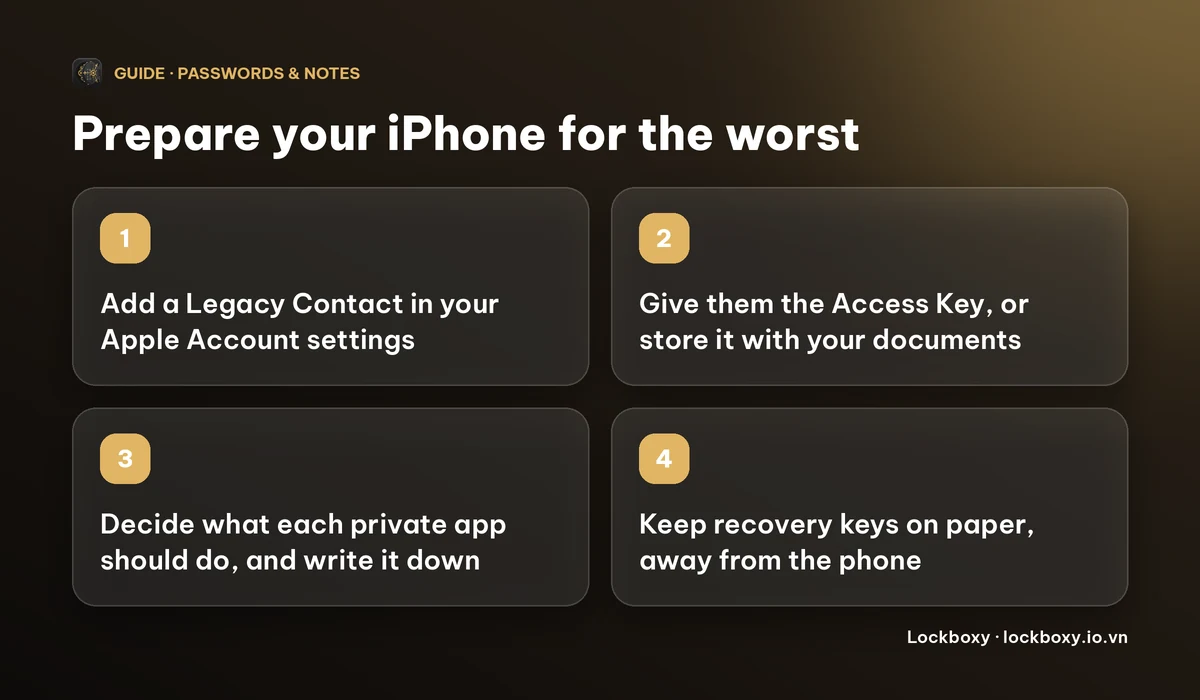
Legacy Contact needs iOS 15.2 or later. Steps can differ slightly between versions:
- 1Open Settings and tap your name at the top.
- 2Tap Sign-In & Security (called Password & Security on some versions), then Legacy Contact.
- 3Tap Add Legacy Contact and confirm with Face ID, Touch ID or your passcode.
- 4Choose a person from your contacts or Family Sharing group, and follow the prompts.
- 5Share the Access Key: send it to them or print it. Without the key they cannot make a request, so keep a printed copy with your important papers or give it to them directly.
You can usually add more than one Legacy Contact. They need your Access Key and a copy of your death certificate, and Apple verifies the request before giving access. Check Apple's own support page for the current rules.
What does a Legacy Contact get, and what not?
Roughly: data stored in your Apple Account, such as photos in iCloud Photos, notes, files in iCloud Drive, contacts and messages in iCloud. Apple lists the exact categories on its support page.
Not included: your saved passwords and Keychain items, and purchased media or licences. And anything that is only on the phone and not in iCloud is not part of this, because Apple does not hold it.
Apps from other developers that keep their own encrypted data are in that last group. Whether anyone can open them depends entirely on the app.
What about passwords and private vault apps?
Passwords: write down how to reach your password manager (its master password or emergency kit) and put it on paper with your important documents. See How to store passwords safely on your phone.
Vault apps: decide on purpose whether you want anyone to be able to open them. If you do, check what the app offers. A vault that is encrypted with a key made from your passcode usually has no reset and no emergency access, so the content is gone unless you made a recovery key or backup. If you do not want anyone to see it, that same design protects you.
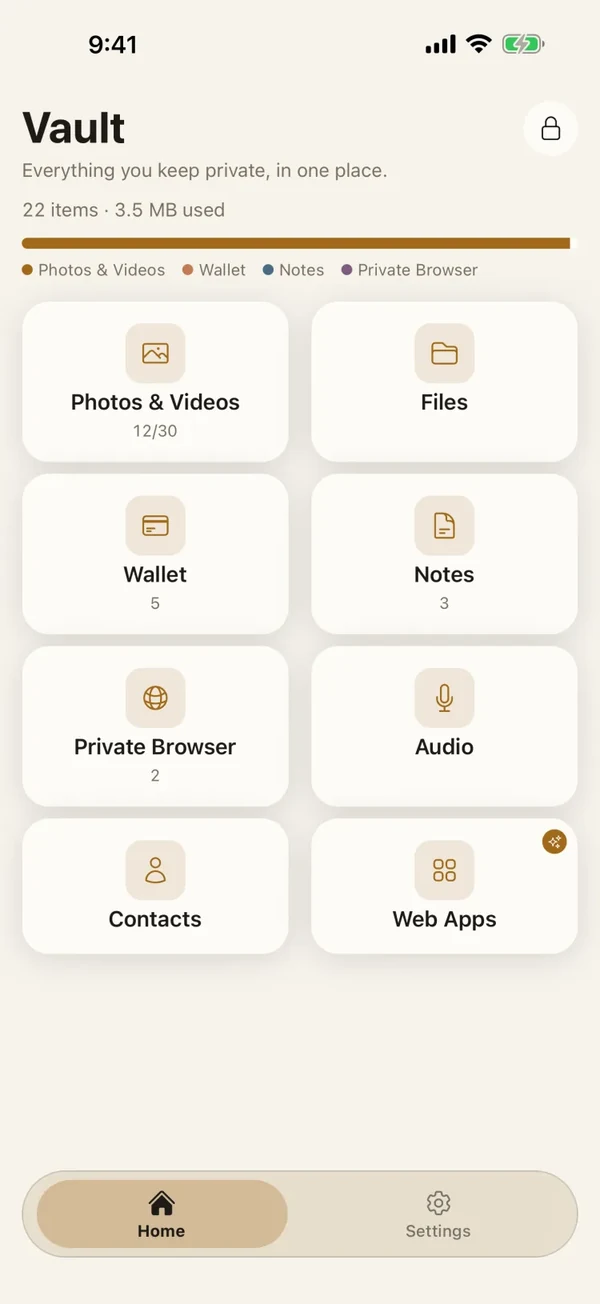
How Lockboxy works: it keeps no copy of your passcode, there is no reset link and no emergency-access or inheritance feature, and its vault is excluded from iPhone's own iCloud and computer backups. The way back is a Recovery Key you set up in advance (Settings → Security → Set Up Recovery Key, a Premium feature; it is an 80-digit key shown once) or an encrypted backup file (Settings → Back Up Vault, also Premium) that opens with your passcode or Recovery Key. Using a key you already have does not need Premium. The free plan holds up to 30 photos or videos and 10 files.
So with Lockboxy, a person you trust can get in only if you give them the passcode or a Recovery Key. See Forgot the passcode of your private photo vault app? for how recovery works.
A simple plan you can finish in 30 minutes
- Add a Legacy Contact and hand over the Access Key.
- On one sheet of paper, list: your phone passcode, how to reach your password manager, and which private apps exist.
- For each private app, write one line: “open it” (and how) or “leave it locked”.
- Store the paper where your trusted person can reach it, such as with a will or in a safe, not in a notes app on the phone.
- Review it once a year, or after changing a passcode. Other accounts, like your email, may have their own inactive-account settings.
- Also see What to do when your iPhone is lost or stolen for the opposite problem, a phone in the wrong hands.
Frequently asked questions
Can my family unlock my iPhone after I die?
Not without your passcode. Apple's Legacy Contact feature gives a person you choose a way to request access to some Apple Account data, but it does not unlock the phone itself.
Does a Legacy Contact get my passwords?
No. Saved passwords and Keychain items are not included, so record how to reach your password manager separately.
What happens to a vault app after I die?
It depends on the app. If it encrypts on the device with no reset, the content stays locked unless someone has your passcode, a recovery key or an unlocked backup path.
Does Lockboxy have emergency access for family?
No. Lockboxy has no emergency-access or inheritance feature and keeps no copy of your passcode. A trusted person can open it only with your passcode or a Recovery Key you gave them.
Is setting a Recovery Key in Lockboxy free?
Setting one up is a Premium feature. Using a Recovery Key you already have is not locked behind Premium.
Want a private place with its own passcode?
Lockboxy encrypts photos, videos, files and notes on your device, behind a passcode separate from your phone's. No account, no server.
Get Lockboxy on the App StoreMore guides
- Forgot the passcode of your private photo vault app? What you can and can't recover
- How to store passwords safely on your phone
- What to do when your iPhone is lost or stolen
- How to hide photos on iPhone (and what “hidden” really protects)
- How to lock apps on iPhone: Face ID lock, hiding apps and older-iOS workarounds
- How to store photos of your ID safely on your phone
- How to permanently delete photos on iPhone (and every copy you forgot)
- How to lock notes on iPhone with a password or Face ID
- How to lend your iPhone without exposing your photos
- How to store a seed phrase safely (and what not to do)
- What to do before sending your iPhone for repair
- How to take photos that don't save to your iPhone camera roll
- How to scan documents on iPhone (no app needed) and store them safely
- How to store 2FA backup codes safely (and where not to)
- How to handle sensitive screenshots on iPhone (bank transfers, OTPs, IDs)
- How to keep voice recordings private on iPhone
- How to stop iPhone photos syncing to your iPad and Mac
- How to erase your iPhone before selling it
- Lockboxy vs the iPhone Hidden album: which should you use?
- Lockboxy vs locked notes on iPhone: which is better for private notes?
- Phone privacy for livestream sellers: keep customer data off the stream
- Keeping client documents private: a phone routine for real-estate agents
- How to hide contacts on iPhone: what really works
- How to tell if someone went through your iPhone
- How to move private photos to a new iPhone
- How to password protect a folder on iPhone
- How to remove location data from photos on iPhone before sharing
- How to store bank card details safely on your phone
- How to find and share a saved Wi-Fi password on iPhone
- How to stop unwanted photos from showing up in Memories and Featured Photos on iPhone
- How to control which photos an app can access on iPhone
- How to find the Hidden album on iPhone (and why it may be missing)
- How to show someone a photo on your iPhone without them swiping to the others
- How to stop WhatsApp saving photos to your iPhone camera roll
- How to stop photos from Messages showing up in your iPhone Photos app
- How to password protect a video on iPhone
- How to password protect a PDF on iPhone
- What does Private Browsing on iPhone actually hide?
- Where do downloads go on iPhone? How to find, move and delete them
- How to hide private content in the iPhone App Switcher
- How to back up your iPhone photos without iCloud
- How to stop photos from showing up in iPhone Spotlight search
- What can someone do with your locked iPhone? How to limit Lock Screen access
- Why is there a green or orange dot on my iPhone? How to see which app is using your camera or microphone
- How to keep a private journal on iPhone
- How to stop unwanted AirDrops on iPhone
- How to keep medical documents and insurance cards private on iPhone
- How to change or remove the camera button on the iPhone Lock Screen
- You copied a password on iPhone: who can see your clipboard, and how to stop apps pasting from it
- What is Stolen Device Protection on iPhone, and should you turn it on?
- Where to store PIN codes and door codes on iPhone
- How to share a password with family on iPhone without sending it in a chat
- Where to store your Apple Account recovery key (and what if you lose it)
- How to see saved passwords on iPhone (and what to do when one is missing)
Questions about how Lockboxy works? Read the FAQ